


A 1966 Ford Mustang GT Convertible sold for $67,725 including fees through AllCollectorCars Auctions as Lot #7954. Finished in Ivy Green Metallic with a restored White and Green Pony interior, this dealer-listed example from Bettendorf, Iowa features its A-Code 289ci 4-Barrel V8, a 3-speed manual transmission, the full GT Package, and approximately 7,000 miles—a combination that places it firmly among the most desirable first-generation Mustangs on today’s market.
Few cars changed the American automotive landscape as decisively as the Ford Mustang. Launched in April 1964, it created an entirely new category—the pony car—and sold over a million units within its first eighteen months. By 1966, Ford had refined the formula, and the Mustang GT Convertible emerged as one of the most coveted variants of that formative era.
First-generation Mustangs, particularly those built before 1967’s larger redesign, remain highly sought after by collectors for their compact proportions, clean styling, and direct connection to the model’s origin story. Convertibles from this window carry even greater appeal, combining open-air driving with the performance credentials the GT Package introduced.
This particular example, offered by a dealer out of Bettendorf, Iowa, checked many of the boxes serious Mustang collectors look for: a desirable A-Code V8, a manual transmission, factory GT equipment, and a quality restoration that preserved the car’s period-correct character. Its $67,725 result offers a useful benchmark for anyone tracking the first-generation Mustang market—and a clear illustration of what collectors are willing to pay for a well-documented, well-restored GT convertible.
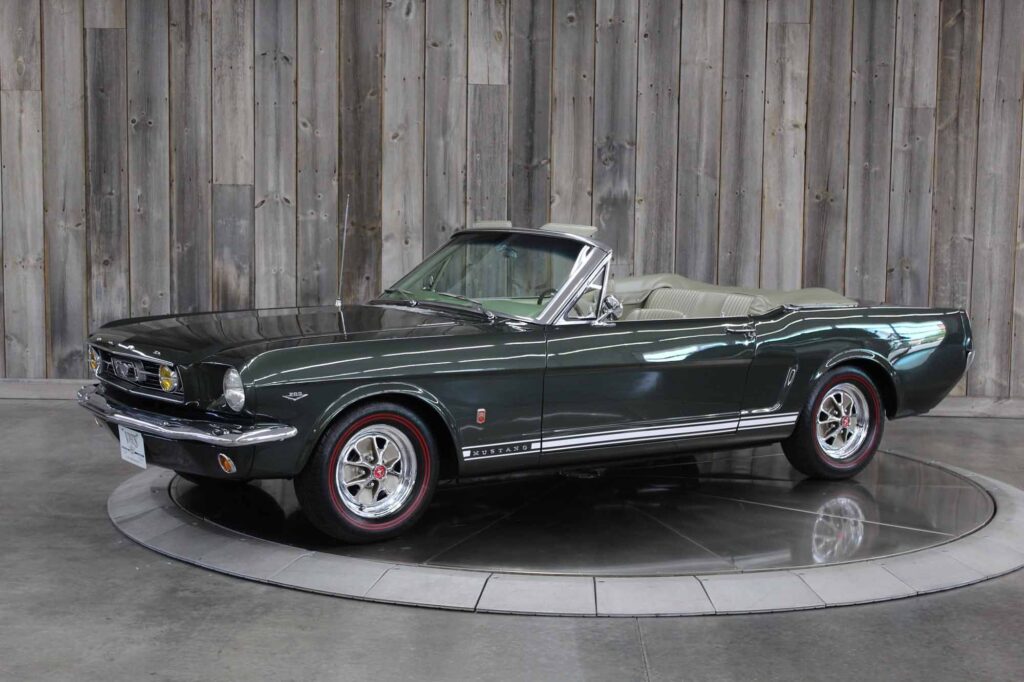
Specifications tell much of the story with any classic Mustang, and this one offers a well-rounded set of factory-correct highlights.
The VIN, 6F08A111146, allows this history to be traced and cross-referenced, giving buyers a path to confirm the car’s factory specifications rather than relying solely on seller claims.
Documentation turns a good story into a confirmed one. For 1966 Mustangs, VIN decoding is the starting point: the code breaks down into details on assembly plant, body style, engine type, and model year, allowing buyers to confirm that a car’s current configuration matches what left the factory.
Beyond VIN verification, organizations such as the Mustang Club of America maintain registries and judging standards that collectors frequently use to benchmark originality and restoration quality. For any serious Mustang purchase, buyers should treat this kind of documentation as a baseline expectation rather than a bonus feature.
The restoration quality on this example—reflected in the condition of its Pony interior and Ivy Green Metallic paint—further supports its standing as a well-preserved, collector-grade vehicle rather than a car that has simply been made to look the part.
A $67,725 result, including fees, reflects steady and sustained collector demand for well-documented, manual-transmission Mustang GT convertibles. Several factors likely supported that price:
Compared to six-cylinder or automatic-equipped 1966 Mustangs, GT convertibles like this one typically command a meaningful premium—particularly when paired with a desirable color combination and a quality restoration.
The 1966 model year represents something of a sweet spot for first-generation Mustangs. It retained the clean, original styling introduced in 1964½ while benefiting from two years of production refinements, before the more substantial redesign arrived in 1967. For collectors focused on the Mustang’s purest early form, 1966 cars occupy a particularly desirable window.
The GT Package’s role in this story extends beyond trim and badging. It represented Ford’s effort to position the Mustang as a legitimate performance car rather than simply a stylish commuter, laying groundwork for the muscle car era that would follow. Convertible GT models, built in smaller numbers than their hardtop counterparts, add a layer of rarity that continues to support strong collector demand decades later.
For buyers evaluating similar vehicles, investment considerations should include:
This $67,725 result reinforces a market that continues to reward GT-equipped, manual-transmission convertibles with strong restoration quality. As fewer well-preserved examples remain in private hands, values for comparable cars are likely to hold firm, particularly for those with verifiable documentation and period-correct details like the Pony interior.
For collectors considering a similar purchase, the path forward is straightforward: verify VIN and engine codes, request restoration history, and compare recent results to set realistic expectations. A car like this doesn’t just add a convertible to a collection—it adds a documented piece of the Mustang’s earliest, most formative years.
Explore current listings in the Ford Mustang category, browse available convertibles, or check out upcoming muscle car auctions and classic car auctions to see what’s coming to market next.
How much did this 1966 Ford Mustang GT Convertible sell for?
The vehicle sold for $67,725 including fees through AllCollectorCars Auctions, listed as Lot #7954.
What does the A-Code designation mean on a 1966 Mustang?
A-Code refers to the 289 cubic-inch, 4-barrel carbureted V8 engine option offered in 1966. It represented a mid-tier performance choice, positioned above the base six-cylinder and two-barrel V8 but below the top-tier K-Code High Performance 289.
Why do manual transmissions appeal to Mustang collectors?
A manual transmission offers a more direct, engaged driving experience that many collectors view as more authentic to the car’s original performance intent, often making manual-equipped cars more desirable than automatic counterparts from the same era.
What is the GT Package on a 1966 Mustang, and why does it matter?
The GT Package added performance and visual upgrades including fog lamps, GT badging, upgraded suspension, and dual exhaust with quad outlets. It transformed the standard Mustang into a genuine performance model, and GT-equipped cars typically command higher values than standard trims.
Are 1966 Mustang GT Convertibles rare compared to hardtop models?
Convertibles were produced in smaller numbers than hardtops during the 1966 model year, and well-preserved, GT-equipped examples with documented restorations are considered harder to find today, supporting stronger collector demand.


Website and Marketing by 


You must be logged in to post a comment.