


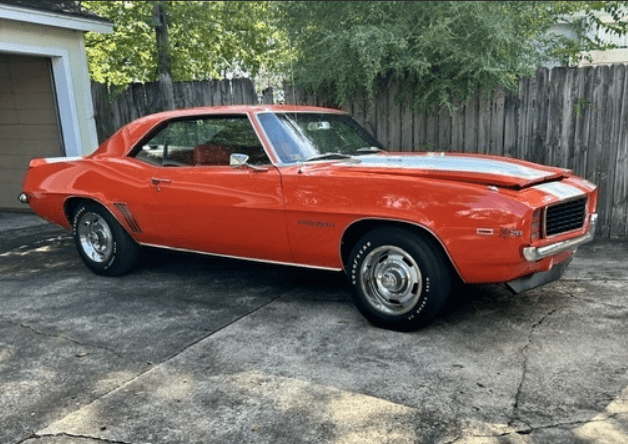
A 1969 Chevrolet Camaro RPO Z28 sold for $65,730 including fees at ACC Auctions, distinguished by its DZ 302 V8, Muncie M21 4-speed manual transmission, and correct Hugger Orange exterior. Jerry MacNeish Inspected with 72,653 original miles, this example represents the second and most celebrated year of the legendary Z28 performance package.
Few muscle cars carry the racing pedigree of the Camaro Z28, and the 1969 model year stands as the pinnacle of that legacy. Born from Chevrolet’s ambition to dominate SCCA Trans-Am competition, the Z28 package transformed an otherwise ordinary pony car into a genuine road-racing weapon, and its reputation has only grown more storied among collectors in the decades since.
That heritage was front and center when this 1969 Camaro Z28 crossed the block at ACC Auctions, closing at $65,730 including fees. For collectors tracking the first-generation Camaro market, this sale offers a useful benchmark for what a well-documented, Jerry MacNeish Inspected Z28 can achieve in today’s climate.
For enthusiasts weighing their next acquisition, or anyone drawn to the engineering ambition behind Chevrolet’s Trans-Am homologation efforts, this result warrants a closer look.
Chevrolet introduced the Z28 option in 1967 as a direct response to SCCA Trans-Am racing rules, which capped engine displacement at 305 cubic inches for competing manufacturers. The resulting DZ 302 V8 was engineered specifically to thread that regulatory needle while still delivering race-ready performance on the street.
The Z28’s entire design philosophy traced back to the racetrack. Chevrolet needed a production-based platform capable of beating Ford’s Mustang and Mercury’s Cougar in SCCA competition, and the 302-cubic-inch displacement limit forced engineers to prioritize high-revving performance over raw torque. The result was an engine built for sustained high-RPM operation, a trait that still defines the Z28’s driving character today.
By 1969, Chevrolet had refined the Z28 formula considerably from its 1967 debut. Production numbers rose as word of the car’s track success spread, but the package remained a specialized order that relatively few original Camaro buyers selected. Collectors consistently favor the 1969 model year because it represents the first-generation Camaro at its performance and styling peak, combining the race-bred DZ 302 with the more aggressive front-end treatment introduced that year. Explore our current Chevrolet Camaro listings to see how comparable examples are valued today.
According to the listing at ACC Auctions, this Camaro (VIN 124379N612514, Lot #7942) presented with a specification sheet that Z28 collectors will recognize as highly desirable:
The DZ 302 earned its reputation through a combination of a forged steel crankshaft, solid lifter camshaft, and high-flow cylinder heads, components borrowed directly from Chevrolet’s racing programs. Rated at 290 horsepower from the factory, the engine was conservatively underrated by most accounts, with many period road tests suggesting real-world output closer to 350 horsepower. Paired with the close-ratio Muncie M21 4-speed, this driveline combination rewarded drivers who kept the engine spinning near its 7,000-RPM redline, exactly the behavior Chevrolet’s engineers designed it for.
Choose a Z28 with the original close-ratio Muncie M21 if authentic period performance matters more to you than modern drivability. The M21’s tighter gear spacing kept the high-revving DZ 302 in its powerband far more effectively than the wider-ratio transmissions found in standard Camaros, a detail that mattered enormously to the car’s original Trans-Am-inspired mission. For collectors evaluating numbers-matching claims, a correctly paired M21 and DZ 302 combination adds meaningful weight to a car’s authenticity.
Jerry MacNeish is widely regarded as one of the foremost authorities on first-generation Camaro authentication, and his inspections carry significant weight within the collector community. A MacNeish Inspection typically evaluates original documentation, body and drivetrain codes, and overall authenticity against factory build records, offering buyers a layer of third-party credibility that goes well beyond a seller’s own claims.
At 72,653 miles, this Camaro shows evidence of regular use rather than garage-queen preservation, a history that many collectors find appealing for a car built to be driven hard. While lower mileage generally supports stronger valuations, a well-documented history of use on a Jerry MacNeish Inspected example can still command strong collector interest, particularly when paired with a correct drivetrain and original color combination.
Hugger Orange remains one of the most recognizable and sought-after color options from the 1969 Camaro lineup, and its pairing with an Orange/Black interior reflects a factory-correct combination that collectors actively seek out. Cars retaining their original exterior and interior colors typically command a premium over repainted or re-trimmed examples, since originality plays such a central role in Z28 valuations.
This Camaro’s final sale price of $65,730 including fees reflects solid collector demand for a documented, correctly equipped 1969 Z28. Several factors likely shaped this result:
Compared to broader trends in the first-generation Z28 market, this result sits within a reasonable range for a driver-quality example with genuine mileage, rather than a numbers-matching, show-caliber restoration. Browse our Muscle Car listings to see how comparable Z28s and their contemporaries are trading today.
Beyond the auction numbers, the 1969 Z28 holds a meaningful place in the history of American performance engineering.
The Z28’s origins in Trans-Am competition give it a motorsport pedigree that few muscle cars can match. Chevrolet didn’t build the Z28 to win at the drag strip; it built the car to win road races against determined competition from Ford and Mercury, and that racing DNA still resonates with collectors who value authenticity over raw horsepower figures alone.
Genuine, correctly equipped 1969 Z28s with documented DZ 302 engines and matching transmissions have grown scarcer as decades of modifications, engine swaps, and heavy use have taken their toll on surviving examples. A Jerry MacNeish Inspected car offers collectors a credible starting point for evaluating authenticity in a market where claims can often outpace documentation.
Well-documented Z28s with credible inspection history have generally shown resilience in the collector market, particularly as interest in first-generation Camaros continues among buyers who remember the era firsthand. Collectors prioritizing verified authenticity over unsubstantiated claims are typically better positioned for long-term value retention.
Owners of solid-lifter DZ 302 engines should budget for more frequent valve adjustments than a hydraulic-cam small-block requires, a tradeoff for the engine’s high-RPM capability. A dedicated network of first-generation Camaro parts suppliers and restoration specialists continues to support these cars with period-correct components. For technical background on the engine itself, the DZ 302’s racing history offers useful context for new collectors.
This Camaro’s $65,730 sale at ACC Auctions reflects steady collector demand for correctly equipped, professionally inspected examples of Chevrolet’s Trans-Am-bred Z28. With its DZ 302 V8, Muncie M21 4-speed, and factory Hugger Orange finish, this example offered a buyer a genuine piece of muscle car racing history at a price that remains accessible compared to numbers-matching, concours-level Z28s.
For collectors weighing their next acquisition, this sale serves as a useful reference point, and a reminder that documented authenticity continues to carry real weight in the Z28 market. As interest in first-generation Camaros remains strong, examples like this one will likely stay firmly on the radar of serious muscle car buyers. Explore the full 1969 Camaro inventory currently available to find your next addition.
How much did this 1969 Chevrolet Camaro Z28 sell for?
The vehicle sold for $65,730 including fees at ACC Auctions.
What makes a Camaro Z28 valuable to collectors?
Value typically hinges on originality, including a correctly matched DZ 302 engine and Muncie M21 transmission, factory-correct colors, documented history, and third-party authentication such as a Jerry MacNeish Inspection.
Is the DZ 302 original equipment on the 1969 Z28?
Yes. The DZ 302 V8 was the factory-specified engine for the Z28 performance package, engineered specifically to meet SCCA Trans-Am displacement rules while delivering high-RPM performance.
How does mileage affect pricing for a collector Camaro like this?
Lower original mileage generally supports stronger valuations, though a well-documented history of use on an inspected, correctly equipped example can still achieve solid collector interest, as this sale demonstrates.
Where can I find similar classic Camaros for sale?
Explore the current 1969 Camaro inventory at All Collector Cars, or browse our broader Chevrolet Camaro and Muscle Car auction listings for comparable opportunities.
Who sold this 1969 Chevrolet Camaro Z28?
The vehicle was listed by a private seller located in Beaumont, TX.
ons.


Website and Marketing by 

You must be logged in to post a comment.