


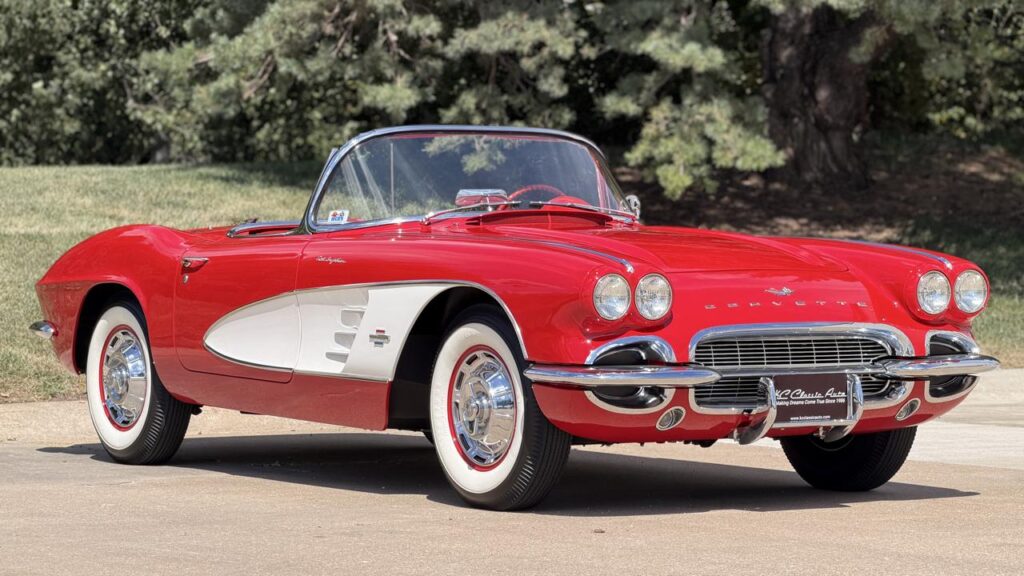
A 1961 Chevrolet Corvette Convertible sold for $115,000 including fees at ACC Auctions, driven by its numbers-matching CS-Code 315hp fuel-injected 283ci V8, 4-speed manual transmission, and 4.11 Positraction rear axle. With an NCRS Top Flight score of 96.1, this Red-on-Red example offered by a dealer in Lenexa, KS represents one of the finest surviving specimens of Corvette’s transitional 1961 model year.
Few American sports cars carry the mythology of the early Corvette, and the 1961 model occupies a particularly fascinating place in that story. It arrived at the close of the first-generation Corvette’s design era, refined by years of engineering lessons yet still carrying the raw, fuel-injected performance that built the nameplate’s reputation on road courses and boulevards alike.
That significance was on full display when this 1961 Corvette Convertible crossed the block at ACC Auctions, ultimately achieving $115,000 including fees. For collectors tracking the first-generation Corvette market, this sale offers a meaningful benchmark for what a documented, numbers-matching, low-mileage example can command today.
For collectors evaluating their next acquisition, or anyone drawn to the engineering ambition of early Corvette, this result deserves a closer look.
The Corvette’s evolution from 1953 to 1961 tells the story of Chevrolet learning, iterating, and ultimately perfecting its sports car formula. The original 1953 model was more showpiece than performer, built in limited numbers with a modest six-cylinder engine. By the end of the decade, Chevrolet had transformed the Corvette into a genuine performance machine, culminating in the fuel-injected V8s that defined the car’s reputation through the early 1960s.
The 1961 model year marked a quiet but important turning point. It introduced a restyled rear end with the “ducktail” treatment that would influence Corvette design language into the next generation, while retaining the chrome-toothed grille and body lines established earlier in the C1 era. Mechanically, 1961 represented the Corvette at its most sorted, with fuel injection technology mature enough to deliver genuinely reliable performance rather than the finicky setups of earlier model years.
Collectors consistently pay a premium for early Corvettes, and the reasons are well documented. Production numbers were modest compared to later generations, fuel-injected examples were a comparatively rare option, and surviving cars with original drivetrains have only grown scarcer with time. A numbers-matching example like this one — where the engine and chassis can be verified as original to each other — carries meaningfully more value than a car with a replacement powertrain, since matching numbers directly support both authenticity and long-term investment potential. Browse our current Chevrolet classic cars at auction to see how comparable examples are priced today.
According to the listing at ACC Auctions, this Corvette Convertible (VIN 10867S104820, Lot #8155) presented with a specification sheet that collectors of first-generation Corvettes will immediately recognize as exceptional:
The CS-Code 283ci V8 represented the pinnacle of Chevrolet’s small-block engineering at the dawn of the 1960s. Fuel injection, developed in partnership with engineer Zora Arkus-Duntov, allowed this engine to produce one horsepower per cubic inch — a benchmark figure that made the fuel-injected Corvette one of the fastest American production cars of its era. Paired with a 4-speed manual transmission and 4.11 Positraction rear axle, this driveline combination favored quick acceleration and confident handling over highway cruising, exactly the setup serious performance buyers sought when the car was new.
Choose a numbers-matching example like this one if long-term value preservation and investment-grade authenticity matter more to you than price alone. A verified original engine and chassis pairing removes any ambiguity about the car’s history, which materially affects both insurance valuations and resale confidence. For C1 Corvettes specifically, where engine swaps and replacement blocks are common after six decades of ownership, numbers-matching status separates a solid driver from a genuine collector-grade investment.
The National Corvette Restorers Society (NCRS) Top Flight award represents one of the most rigorous judging standards in the collector car hobby, evaluating a vehicle against its original factory specifications down to fastener finishes and paint codes. A score of 96.1 places this Corvette firmly among the best-preserved and most accurately restored examples in existence, a detail that carries significant weight for buyers who prioritize documented condition over a seller’s claims alone.
At 7,947 miles, this Corvette has covered a remarkably small distance across more than six decades. That figure suggests a history of careful, limited use rather than daily driving, which helps explain the originality reflected in its NCRS score. Low mileage also reduces the likelihood of mechanical wear on numbers-matching components, further supporting the car’s authenticity claims.
The matching Red exterior and Red interior combination is one of the more striking color pairings available on the early C1 Corvette, and its preservation here adds another layer of originality to the overall package. Collectors who prioritize factory-correct presentation will recognize this as a car that has avoided the repaints and interior swaps common among lesser-preserved examples.
This Corvette’s final sale price of $115,000 including fees reflects strong, sustained demand for documented, numbers-matching examples of the fuel-injected C1 Corvette. Several factors likely contributed to this result:
Compared to broader market trends for 1961 Corvette convertibles, this result sits toward the upper end of the range, reflecting the combined premium collectors pay for documentation, originality, and condition working together rather than any single factor alone. View other classic convertibles currently available at ACC Auctions to explore comparable opportunities.
Beyond the auction figures, the 1961 Corvette carries genuine significance for collectors who view their vehicles as both investment and legacy.
The early Corvette era represents a formative chapter in American automotive engineering, when Chevrolet set out to prove it could build a world-class sports car entirely in-house. The 1961 model, with its refined styling and mature fuel-injection system, stands as evidence that the effort succeeded.
Fuel-injected, numbers-matching C1 Corvettes with NCRS-verified condition represent a genuinely limited pool of surviving vehicles. Decades of attrition, engine swaps, and heavy use have thinned the ranks of cars that can match this level of documentation and originality. Browse our Chevrolet Corvette listings to see what’s currently available at auction.
Well-documented examples of historically significant performance cars have generally proven resilient against broader market fluctuations. Collectors prioritizing verified authenticity and condition when acquiring vehicles like this Corvette are typically better positioned for long-term value retention.
Owners of early fuel-injected Corvettes should budget for specialized maintenance of the Rochester fuel-injection system, which requires more specialized knowledge than a standard carbureted setup. Fortunately, a dedicated network of Corvette restoration specialists and parts suppliers continues to support the C1 generation with period-correct components.
This Corvette’s $115,000 sale at ACC Auctions reinforces a clear pattern in the collector market: documented, numbers-matching examples of early fuel-injected Corvettes continue to command serious premiums. With its verified CS-Code 283ci V8, NCRS Top Flight certification, and remarkably low original mileage, this example offered a buyer a rare combination of authenticity, performance pedigree, and investment-grade condition.
For collectors evaluating their next acquisition, this sale serves as a valuable reference point — and a reminder that the market continues to reward cars with verifiable history over unsubstantiated claims. As interest in first-generation Corvettes remains strong, examples like this one will likely remain firmly on the radar of serious collectors. Explore all classic cars currently at auction on ACC to find your next addition.
How much did this 1961 Chevrolet Corvette Convertible sell for?
The vehicle sold for $115,000 including fees at ACC Auctions.
What engine does the 1961 Chevrolet Corvette Convertible have?
It’s equipped with a numbers-matching CS-Code fuel-injected 283ci V8 producing 315 HP, paired with a 4-speed manual transmission and 4.11 Positraction rear axle.
How many miles does this Corvette have?
The listing recorded 7,947 original miles at the time of sale.
Who sold this 1961 Chevrolet Corvette Convertible?
The vehicle was listed by a dealer located in Lenexa, KS.
What does an NCRS Top Flight score of 96.1 mean?
It reflects a rigorous evaluation by the National Corvette Restorers Society confirming the car closely matches its original factory specifications, indicating exceptional originality and condition.
Is the 1961 Chevrolet Corvette Convertible a good investment for collectors?
Numbers-matching, low-mileage examples with NCRS certification like this one tend to hold value exceptionally well, given their documented authenticity and the increasing scarcity of fuel-injected C1 Corvettes.


Website and Marketing by 


You must be logged in to post a comment.